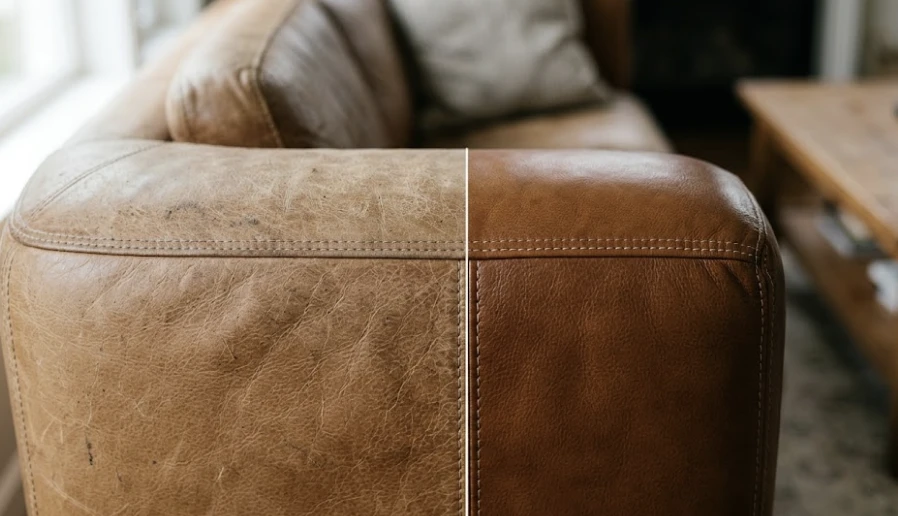
The most expensive leather sofa a Lynnwood upholstery cleaner is likely to be called about isn’t necessarily the oldest one in the house. More often it’s a three-year-old couch treated with the wrong conditioner from the start, or a five-year-old piece where someone has been wiping it down with baby wipes because they assumed that was safe. Leather doesn’t deteriorate from use. It deteriorates from the wrong kind of care applied consistently over time.
Understanding why starts with something most furniture buyers skip entirely: figuring out what type of leather they actually own. The label on the showroom floor almost never specifies this. The salesperson often doesn’t know either. But the difference between full aniline leather and protected corrected-grain leather is the difference between a surface that absorbs any liquid applied to it — conditioner, cleaner, spilled coffee — and one with a polymer coating that fundamentally changes how every product interacts with it. Clean an aniline piece with a cleaner formulated for protected leather and you’ve under-cleaned it. Clean a protected piece with products made for aniline and you risk stripping the coating that protects both the dye and the hide beneath.
The four main categories showing up in Lynnwood living rooms are full aniline, semi-aniline, protected (corrected grain), and bonded leather. Full aniline is dyed through with no surface coating — the natural grain variation and hide markings are visible, and it develops a patina with age. It’s also the most sensitive to moisture, oils from skin contact, and UV exposure. Semi-aniline has a light surface pigment layer that provides some stain resistance without hiding the natural character of the hide. Protected leather is the most common in mid-range furniture — a uniform coating over corrected grain gives it the consistent appearance that’s easier to mass-produce, and that coating provides real stain resistance. Bonded leather is a different category entirely and worth a separate conversation.
The Pacific Northwest Climate Creates a Specific Problem for Leather
Leather is skin. It responds to humidity the same way skin does — absorbing moisture when ambient humidity is high, drying out when conditions are dry. The western Washington climate runs a humidity cycle that most leather care instructions, written for general national markets, don’t account for. From October through March, indoor relative humidity in an uncontrolled Lynnwood home commonly sits between 50 and 70 percent. Run forced-air heat through that winter and you create a seasonal humidity swing: high outdoor humidity, dry indoor heat from the furnace, windows closed for months. The leather on your sofa cycles through this repeatedly.
What this does over time: leather that isn’t conditioned regularly in a dry-heat environment loses moisture from the hide itself, not just the surface. The fibers in the hide stiffen, micro-cracks develop along natural grain lines first, and the piece ages faster than it should. In a purely rainy climate this process is sometimes offset by ambient moisture, but once indoor heating dries the air, the effect accelerates significantly. The conditioning schedule that works in Sacramento doesn’t work in Lynnwood.
The practical adjustment: protected leather in a western Washington home likely needs conditioning two to three times annually rather than the once-a-year recommendation in most care guides. Aniline and semi-aniline pieces need it more. This isn’t a pitch for conditioner product sales — it’s a recognition that the environmental load on leather furniture in the PNW is specific to the climate, and generic schedules written for drier regions don’t account for it.
What Common Cleaning Products Actually Do to Leather
Baby wipes are the most consistently damaging leather cleaner people use without realizing it. Most baby wipes contain alcohol, fragrance, or propylene glycol — all of which strip oils from leather over repeated use. They clean the surface in the short term and degrade the surface chemistry over months. The couch looks fine after each wipe. Six months later the coating is visibly dulled, the surface feels slightly tacky in places, and conditioning won’t fully reverse it.
Dish soap diluted in water is a common DIY recommendation online. The problem is pH. Leather sits at roughly pH 4 to 5 — mildly acidic. Most dish soaps are formulated at pH 8 to 9. Repeated cleaning with an alkaline solution gradually changes the leather’s surface chemistry, reduces its natural flexibility, and accelerates color loss on anything but the most heavily pigmented protected leathers. This happens slowly enough that most people never connect the product to the result.
The same pH concern applies to general-purpose household cleaners. Products designed for hard surfaces are formulated for materials that don’t care about pH — tile, countertops, glass. Leather cares. Products specifically formulated for leather cleaning are pH-balanced to match the material. That’s not a marketing claim — it’s the reason they produce different results than a diluted all-purpose spray.
Conditioning — the Part Most People Get Wrong
The most common conditioning mistake is product selection. Most home goods stores stock leather conditioner sections dominated by silicone-based products. Silicone conditions in the short term — the leather looks great immediately after application, feels soft. The problem is that silicone forms a film on the leather surface that blocks moisture exchange and, over multiple applications, builds up a layer that prevents any future conditioner from penetrating to the hide. You’ve effectively sealed the surface. The couch looks fine for a few months, then ages faster because nothing can get through the silicone barrier to do any real conditioning work.
Oil-based conditioners — lanolin, neatsfoot oil — penetrate the hide more effectively, which is what conditioning is actually for. They don’t produce the immediate visual effect of silicone, but the protection they provide is real. Neatsfoot oil has been used in leather care for generations because it works on the hide at a structural level, not just at the surface. The tradeoff is that it can slightly darken lighter leathers with repeated application — on natural tan or light aniline leather, test a small hidden area first.
For protected leather — the most common type in Lynnwood homes — purpose-formulated products from brands like Leather Honey or comparable automotive and furniture leather conditioners provide a reasonable balance of penetration and surface care without silicone buildup. These aren’t luxury products. They’re mid-tier options that actually work and are available at most auto parts stores for less than the silicone alternatives at the furniture boutique.
When a Leather Sofa Needs Professional Cleaning
DIY cleaning handles routine maintenance on protected leather reasonably well. There are specific situations where it doesn’t, and attempting to address them at home often makes the problem harder to fix professionally afterward.
Pet urine on leather doesn’t just affect the surface. Urine contains uric acid crystals that, once the visible moisture evaporates, remain in the material and continue to react with the leather. Odor from a leather piece that has been through a pet incident doesn’t disappear with surface cleaning — the source is inside the material, and addressing it requires cleaning chemistry that penetrates to the hide and neutralizes the uric acid rather than masking the smell. DIY enzyme products applied without controlled penetration technique typically don’t reach deep enough to address the source. You treat the surface, the smell returns when the weather is damp.
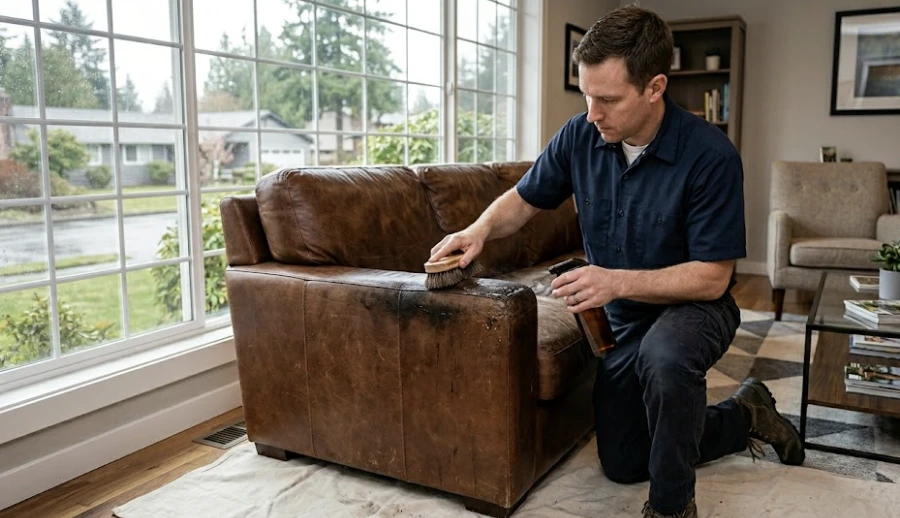
Deep soiling from skin oils, grease, or accumulated grime — the kind that builds up on armrests and headrests over years of contact — doesn’t respond to surface wiping because the soiling has bonded to the leather at a level that surface products aren’t designed to reach. The professional approach uses a multi-stage sequence: a light solvent-based pre-treatment to break the bond, followed by a pH-balanced cleaner, followed by conditioning. The sequence matters as much as the product selection.
If the leather is cracking, professional cleaning won’t reverse it, but it can stabilize the surface and slow further deterioration. Cracking in protected leather typically indicates the polymer coating has failed, and at that stage the remediation options are leather re-dyeing and recoating — a specialist service beyond standard cleaning — or acceptance that the piece has passed the point of restoration. A competent professional will tell you which situation you’re in before quoting any work.
For Lynnwood homeowners who’ve reached that point with a piece, or who are dealing with pet incidents, grease buildup, or a sofa that hasn’t been professionally cleaned in years, a service that specializes in leather couch cleaning in Lynnwood will assess the leather type before quoting anything and explain their method relative to the specific material. A quote that doesn’t begin with identifying what type of leather you have is a quote from someone who hasn’t asked the only question that determines their entire approach.
Bonded Leather — a Separate Category
Bonded leather — also sold as bicast leather, reconstituted leather, or sometimes just “leather” on lower price-point furniture — is not leather in the same sense as any of the above. It’s a manufactured material: leather scraps and fibers bonded to a polyurethane backing, then embossed with a grain pattern. It has none of the structural integrity of genuine leather, and its failure mode is delamination — the polyurethane coating peels away from the backing in sheets or flakes.
Once delamination starts, it cannot be stopped or reversed by cleaning or conditioning. The piece is structurally failing, and no surface treatment addresses that. The frustrating part is that bonded leather can look identical to genuine leather for two to four years, then begin peeling suddenly and progress quickly. A piece in apparently good condition can look ruined within six months once the process starts.
Bonded leather should not be cleaned with oil-based conditioners, which can accelerate delamination by loosening the bond between the polyurethane and the backing. Light, dry maintenance with a barely damp cloth is the appropriate routine. Professional cleaning on bonded leather is generally not worth the cost unless the piece is otherwise in excellent condition — a competent professional will tell you this upfront rather than take a cleaning fee for a piece that’s already in delamination failure mode.
A Maintenance Routine That Actually Holds Up
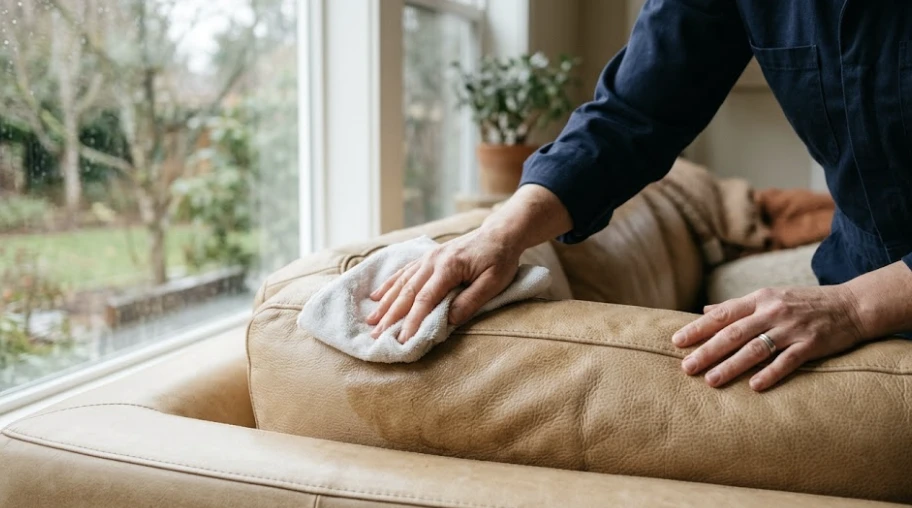
For genuine leather — aniline, semi-aniline, or protected — a practical Lynnwood maintenance routine: vacuum monthly with an upholstery attachment to keep grit from abrading the surface. Wipe down contact areas with a clean, barely damp cloth to remove surface dust and light grime. Apply a pH-balanced leather cleaner to high-contact areas every three to four months. Condition with a penetrating oil-based conditioner two to three times per year, more often if the leather shows any early dryness or stiffness.
Keep the piece away from direct sunlight — UV exposure fades and dries leather regardless of type, and UV-blocking window film is worth the investment if the sofa sits near a window that gets significant afternoon sun. Run a humidifier in the main living area during heating season to moderate the humidity swings described above. And when something gets on the leather that isn’t routine grime — a spilled drink, a pet incident, grease — address it before it sets. The first hour after a spill is always more recoverable than two days later.
None of this is complicated. It’s specific in ways that general care instructions tend not to be, and consistent in a way that most people aren’t until the couch already needs help. The leather furniture that holds up well in Lynnwood homes isn’t always the most expensive — it’s the most consistently and correctly maintained.