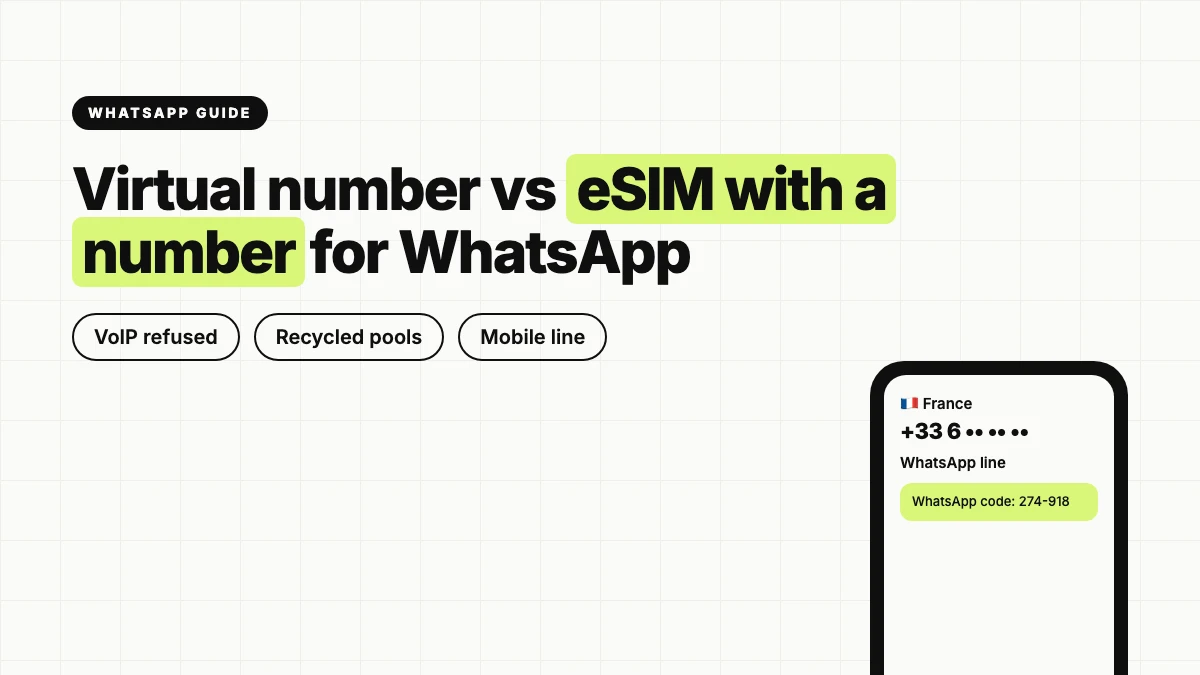
Most searches for “a virtual number for WhatsApp” come from someone who wants a second account. One for work, one for selling things online, one for a trip, one that isn’t attached to the SIM their bank knows. The follow-up question is always the same: which kind of number will WhatsApp keep, and which one will it kill?
A useful answer starts by pulling apart three problems that usually get lumped together as “getting banned.” They have different causes, and the number you choose affects each one differently.
Refused, banned or lost: three separate failures
When people say a WhatsApp number “didn’t work,” they almost always mean one of these:
- Refused at signup. WhatsApp registers with an SMS or voice code. If that code never reaches you, there is no account to ban in the first place.
- Banned after signup. WhatsApp bans numbers it associates with spam or automation. The account exists, then it stops working.
- Lost later. If you lose access to the number, re-verifying the account later requires that number. No number, no way back in.
Why app numbers struggle to get in
In this context, “virtual number” almost always means VoIP: a number that lives inside an app or web service rather than on a mobile network. Burner and Hushed are VoIP. Google Voice and TextNow are too.
The mechanism to understand is the line-type lookup. Plenty of services run one automatically, and it sorts a number into mobile, landline or VoIP. Anti-fraud teams frequently refuse the VoIP category, since such numbers cost little, get thrown away easily and are leased in large batches. To them, a VoIP result says little about whether a real person is on the other end.
That explains a familiar pattern: banks and some apps often turn down Google Voice and TextNow numbers. Google Voice has a catch of its own. Getting one takes a Google account plus an existing US number that isn’t VoIP to verify against, so even when it works, it sits one step away from the main number you were trying to keep out of the picture.
Nobody outside WhatsApp can say how it will treat a particular app number on a particular day, and sellers who promise otherwise are guessing. A VoIP number simply arrives carrying a label a mobile number doesn’t.
Recycled numbers: how accounts quietly disappear
The second kind of “virtual number” is the rented verification number, sold by cheap one-time services that give you a number just long enough to receive a single code. These draw from recycled pools. Once your code is used, the number returns to circulation, and whoever rents it next can read codes sent to it, yours included.
For WhatsApp, that is close to the worst arrangement possible. Re-verifying an account requires the number it was registered on, and that number is now in a stranger’s hands. If verification is ever needed again, the code goes to them.
Public “receive SMS online” sites are a blunter version of the same idea. Any visitor to the page can trigger a login code for an account tied to that number, read it off the screen and walk into the account.
Pool numbers also come with a past. Since WhatsApp bans numbers it associates with spam or automation, a number that has passed through many hands may already carry an association you had nothing to do with.
What a number on a mobile network changes
The alternative is a number that runs on a mobile network: a carrier SIM, or an eSIM that includes a phone number. Dual SIM is standard on most recent phones, as one physical SIM with one eSIM or as two eSIMs, so the second line can live beside your main one.
Know what you’re buying. An eSIM with a number carries two identifiers: the IMSI identifies the subscription, and the MSISDN is the dialable number. Data-only travel eSIMs lack the MSISDN, so a WhatsApp code has nowhere to arrive.
Several providers sell eSIMs with a number attached, and Cypher eSIM is one of them. Its plans bundle SMS, mobile data and calling both ways on one profile, and checkout asks for no account, email or ID. The number is carried by a mobile network, not by an app, so it doesn’t fall into the app-based VoIP bucket. Before you pay, the plan card states the number’s country: a French +33 number on European plans, local numbers for some destinations. Before selling the numbers, the company bought one for itself and tested it, and verification codes were delivered. For the technical side, here is how an eSIM with a real phone number works.
For WhatsApp, that makes the first two failures less likely. The number doesn’t present as app-based VoIP, and for the length of the plan it’s your line, not something passed to the next renter after your login.
What doesn’t change is behavior. An account that sends bulk messages or runs automation is exposed to the same ban on any kind of number. And no seller can guarantee that a particular bank or app will take a particular number.
It also doesn’t hide the handset. Every phone reports its IMEI to the network, so adding an eSIM to your everyday phone leaves both lines in the same device. Buying without ID keeps your name off the purchase; it does nothing about what the phone tells the network. Real separation takes a second device.
Keeping the account when the number expires
This is where the third failure comes back. A time-boxed eSIM plan gives you the number for the life of the plan and no longer. It suits a trip or a project; it isn’t built to be your number for years. WhatsApp, meanwhile, needs that number if it ever asks you to verify again.
Match the number to how long the account has to live. A WhatsApp account for a two-week trip, a short contract or a one-off sale fits a time-boxed number, provided the plan covers the whole period. An account you expect to keep for years belongs on a line you’ll keep for years, which for most people means their home number.
Turn on two-step verification and set a PIN on the day you register, and store the PIN somewhere you won’t lose it.
Keep the home line alive. A common travel setup is to leave the home SIM active for bank codes and calls and put data and a second number on a travel eSIM. The accounts you care about long term then never depend on a number with an end date.
So which one gets banned? A VoIP or pool number is more likely to be refused at the door or lost later. A mobile-network number avoids those two traps for as long as the plan runs. Neither protects an account that behaves like a spammer.
FAQ
Will WhatsApp accept an eSIM number? Nobody selling numbers can guarantee that. A mobile-network number avoids the VoIP result that lookups give app numbers, which removes one common reason numbers get turned away.
What happens to my WhatsApp account when the eSIM plan ends? The number ends with the plan, and any later re-verification needs that same number. If you need the account beyond the plan, register it on a line you’ll keep.
Can I register WhatsApp on a data-only eSIM? No. Without an MSISDN there is no dialable number, so neither the SMS code nor the voice code can reach it.