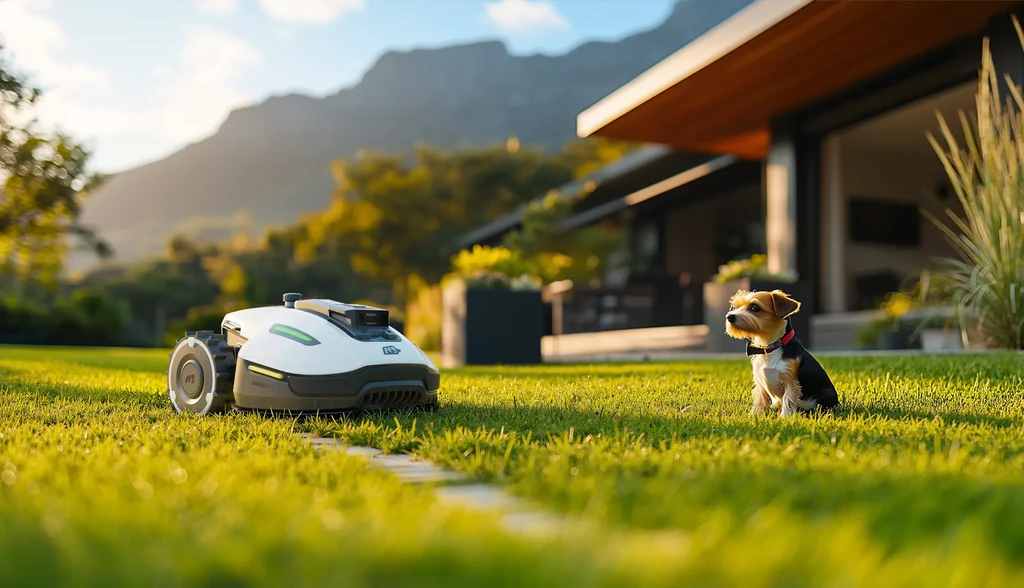
Canadian summers are as precious as they are fleeting. From late May through September, warm sunshine and outdoor living take center stage across cities like Toronto, Vancouver, Calgary, and Montreal. However, maintaining a pristine lawn during this accelerated growing season presents a unique set of challenges. Rapid turf growth demands frequent mowing, yet Canadian homeowners face limited weekend hours, rising fuel prices, strict suburban noise ordinances, and unpredictable weather shifts.
When evaluating how to manage property upkeep, the central debate often comes down to choosing between classic lawn care equipment and autonomous technology. Is investing in a modern robot lawn mower Canada homeowners can rely on worth it compared to traditional options? Below, we examine performance, long term cost efficiency, and convenience to determine the best solution for Canadian yards.
The Dilemma of Traditional Mowers: Gas and Electric Options
For decades, gas powered mowers served as the standard choice for residential properties. While they offer undeniable cutting power for thick grass, their drawbacks have become increasingly difficult to ignore in modern neighborhoods.
First, operational costs continue to rise. High gasoline prices across Canadian provinces make every summer standard fill up noticeable. Beyond fuel expense, gas engines require periodic maintenance including oil changes, spark plug replacements, air filter cleanings, and winterization storage procedures. Furthermore, gas engines emit significant noise levels often exceeding 90 decibels, strictly limiting mowing hours during early mornings or late evenings due to local noise bylaws.
Corded and battery electric mowers emerged as a cleaner alternative, reducing noise emissions and eliminating gasoline hassle. However, electric units still require manual labor. Pushing a heavy deck across a wide suburban yard under the summer heat claims hours of valuable weekend relaxation time that could otherwise be spent with family or enjoying outdoor recreation.
The Autonomous Advantage: Why Smart Mowers Fit Canadian Summers
Automated lawn care shifts the operational paradigm entirely. Rather than waiting for grass to grow tall and spending two hours cutting it every Saturday, autonomous mowers trim small fractions of grass blades daily or every few days. This frequent micro cutting technique offers distinct agronomic and lifestyle advantages for Canadian properties:
- Healthier Turf through Mulching: Tiny grass clippings fall directly into the soil root zone, acting as a continuous natural fertilizer. This preserves moisture during dry midsummer stretches and promotes denser, greener grass.
- Zero Weekend Labor: Automated scheduling allows homeowners to enjoy pristine turf without spending summer afternoons pushing heavy machinery.
- Quiet Operation: Operating at low noise thresholds, smart mowers can run silently at night or during early morning hours without disrupting neighbors.
- Low Energy Consumption: Electric charging costs pennies per cycle, resulting in noticeable seasonal savings compared to gas fill ups.
Evaluating Key Factors for Canadian Properties
| Feature Criteria | Gas Mowers | Traditional Electric | Robotic Mowers |
| Time Required | 1 to 2 hours weekly | 1 to 2 hours weekly | Zero manual mowing time |
| Maintenance | Oil, spark plugs, gas refills | Battery care, blade sharpening | Minimal blade replacement |
| Noise Impact | High (above 90 dB) | Moderate (70 to 80 dB) | Very Quiet (under 60 dB) |
| Slopes & Terrain | Manual effort required | Manual effort required | Automatic slope navigation |
Selecting the best lawn mower for Canadian lawns
Choosing the ideal lawn care equipment depends directly on property size, perimeter complexity, and yard topography. Modern intelligent systems now utilize advanced visual navigation and optical sensors, eliminating the hassle of burying boundary wires in hard frozen ground before spring setup.
For homeowners evaluating top tier autonomous solutions, the MOVA LiDAX line provides tailored configurations designed for different yard dimensions and terrain requirements:
- Compact & Open Lawns (Up to 0.25 Acre) — MOVA LiDAX Pro 800: Designed for urban properties and straightforward lawns, the MOVA LiDAX Pro 800 utilizes wire free RTK free 3D LiDAR navigation alongside intelligent obstacle detection. It maps yards effortlessly through app controls, providing consistent cutting without perimeter wire installation.
- Lawns with Complex Borders (Up to 0.25 Acre) — MOVA LiDAX Ultra 1000: For yards surrounded by stone walls, decorative gardens, or wooden fences, the MOVA LiDAX Ultra 1000 introduces specialized edge cutting capabilities. Featuring UltraTrim technology, it cuts remarkably close to physical boundaries, significantly cutting down manual border trimming time.
- Medium Standard Properties (Up to 0.5 Acre) — MOVA LiDAX Ultra 2000: Ideal for spacious suburban yards, the MOVA LiDAX Ultra 2000 handles multiple mowing zones through intelligent mapping. It systematically navigates moderate inclines up to 45 percent slope with efficient U shaped cutting patterns, guaranteeing full coverage across broader turf areas.
- Steep Slopes & Rough Terrain (Up to 0.5 Acre) — MOVA LiDAX Ultra 2000 AWD: Properties featuring steep hills, uneven ground, or challenging outdoor landscapes benefit directly from the flagship MOVA LiDAX Ultra 2000 AWD. Equipped with all wheel drive traction, an expansive dual disc cutting deck, and next generation UltraView AI vision, it handles slopes up to 80 percent grade while intelligently steering around complex yard obstacles.
The Final Verdict: Which Is Better?
While traditional gas and electric push mowers still hold a place for initial thick growth clearing, robotic mowers clearly represent the future of residential lawn maintenance in Canada. By eliminating repetitive weekend chores, lowering long term fuel expenses, and maintaining healthier grass through continuous precision trimming, smart autonomous mowers offer an unmatched quality of life upgrade for Canadian homeowners who want to reclaim their summer months.