It’s a typical morning: you wake up to the sound of your smart speaker playing your favorite playlist, the thermostat adjusts to the perfect temperature, and your coffee machine starts brewing without you having to lift a finger. While this might seem like a scene from a futuristic sci-fi movie, it’s becoming an increasingly common reality, thanks to the rapid advancements in artificial intelligence (AI). We’re at the beginning of a technological revolution that’s quietly transforming the way we live, work, and interact with the world around us.
But AI is no longer just a tool for tech giants or research labs; it’s something we all engage with daily, often without even realizing it. From the voice assistants on our smartphones to the algorithms that power our social media feeds, AI is already embedded in many aspects of our daily lives. As AI continues to evolve, it promises even more personalized, efficient, and intuitive experiences that will shape the future of how we live. So, what does the future of AI hold for us? Let’s dive into some of the ways AI is poised to become an even bigger part of our everyday lives.
AI at Home: The Smart Home Revolution
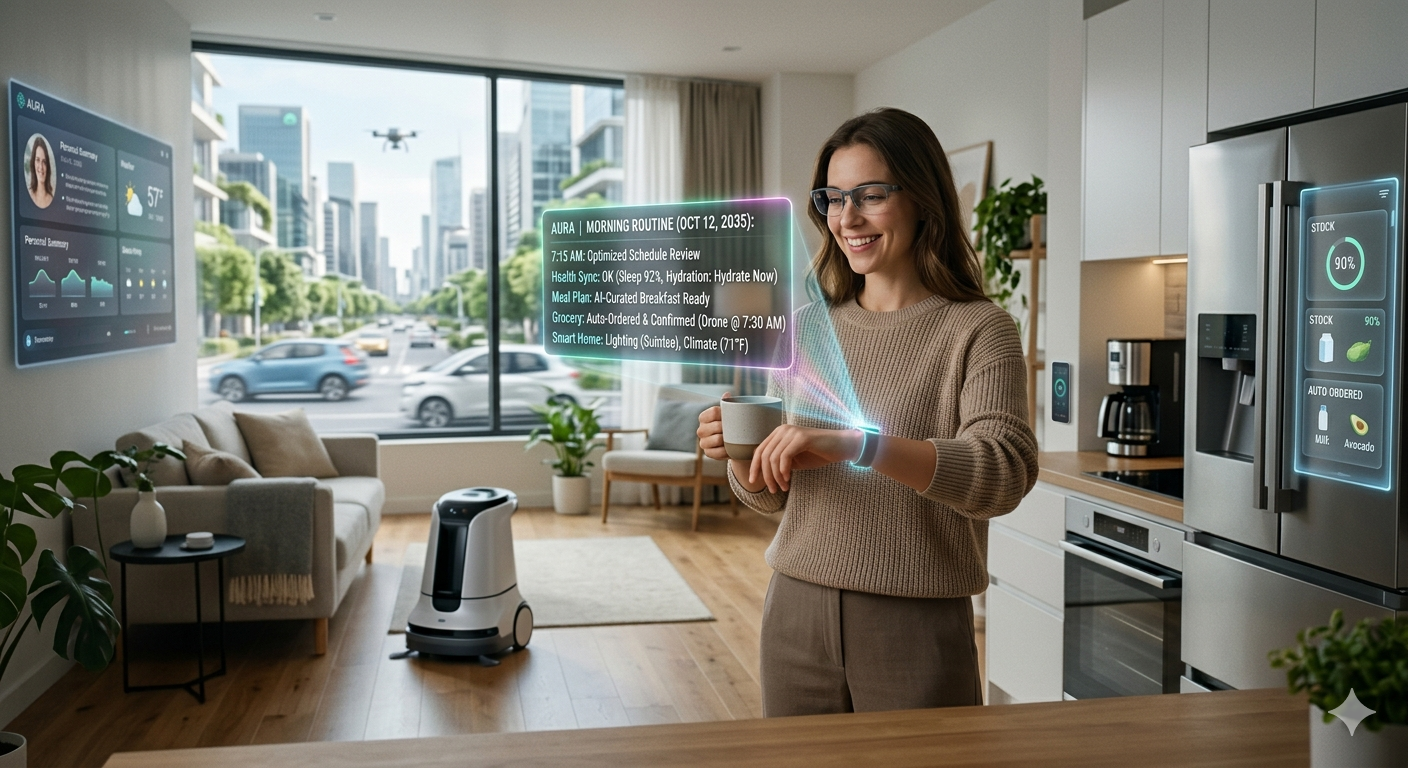
The smart home has already begun to make our lives easier. With devices like smart speakers, lights, thermostats, and security cameras, AI is helping us automate and streamline daily tasks. These technologies can adjust themselves to our preferences, saving time and energy. For instance, your smart thermostat learns when you’re typically home or away and adjusts your heating or cooling accordingly, ensuring your home is always at the perfect temperature when you need it.
But the future of AI in our homes goes beyond convenience. Soon, our homes will become even more intuitive. Imagine an AI system that recognizes your daily habits and anticipates your needs. You wake up, and your AI-powered home already knows you’ll need a cup of coffee, and the machine has it ready by the time you get to the kitchen. It might even adjust the lighting based on your mood, the weather, or the time of day, giving you a personalized environment before you even ask.
AI-powered appliances will also become more energy-efficient over time. Think of refrigerators that not only tell you when you’re low on groceries but can also suggest recipes based on what’s inside and even order ingredients for you. This level of personalization will become commonplace as AI gets better at understanding our preferences and needs.
AI in Communication: Connecting in New Ways
From voice assistants like Siri and Alexa to AI chatbots, communication is one of the areas where AI is already making a significant impact. AI is revolutionizing how we interact with devices, businesses, and even each other. For example, AI text to speech technology has advanced so much that it can now produce voices that sound eerily human. This is already making waves in customer service, where AI-powered chatbots are handling routine queries, giving businesses the ability to offer 24/7 support without the need for human agents.
In the future, this technology will likely evolve even further. Instead of just responding to simple commands, AI assistants will become capable of more complex, meaningful interactions. They could serve as personal advisors, guiding you through decisions, scheduling appointments, or even helping you draft emails with the right tone. In fact, AI text to speech will likely make voice interfaces more natural and fluid, improving accessibility for people who have difficulty typing or using traditional devices.
But it’s not just about convenience for individuals. Businesses are using AI to enhance communication with customers, making the experience more seamless and personalized. For example, an AI system could analyze a customer’s previous interactions with a company and provide a tailored response or recommendation based on that data. This level of personalization, powered by AI, is reshaping how brands engage with consumers.
AI in Healthcare: A Game-Changer for Health and Wellness
One of the most exciting aspects of AI’s future is its potential to revolutionize healthcare. While we’ve already seen some use cases, like AI systems helping doctors analyze medical images and diagnosing conditions like cancer, we’re only scratching the surface of what’s possible. AI has the potential to transform how we manage our health, both in terms of prevention and treatment.
In the future, AI could play a major role in personalized medicine, helping doctors design treatment plans that are tailored to an individual’s unique genetic makeup, lifestyle, and medical history. Imagine a world where AI can predict health risks before they become issues, allowing for early intervention and better outcomes. Wearable devices could monitor your health in real-time, detecting irregularities and sending data directly to your healthcare provider. This constant monitoring could help prevent serious conditions like heart attacks or strokes before they even happen.
But the potential for AI in healthcare goes beyond just early diagnosis. AI could also be used to streamline administrative tasks in healthcare, reducing the burden on doctors and nurses and allowing them to spend more time with patients. Tasks like scheduling, billing, and record-keeping could all be handled more efficiently by AI, improving the overall healthcare experience for both patients and providers.
AI in Transportation: A Smarter Way to Travel
AI is also transforming the way we get around. We’re already familiar with the idea of self-driving cars, but in the coming years, autonomous vehicles will likely become much more common on our roads. These vehicles, powered by AI, will be able to navigate traffic, avoid accidents, and even predict the best routes to take, all while reducing traffic congestion and pollution.
But AI is also making an impact in public transportation. AI-powered smart traffic management systems are being implemented in cities around the world to optimize traffic flow, reduce congestion, and improve safety. These systems use real-time data from traffic sensors, cameras, and GPS devices to adjust traffic signals and routing in response to changing conditions. In the future, AI could even make transportation more environmentally friendly by helping to manage electric vehicle charging infrastructure, ensuring that charging stations are used efficiently and minimizing downtime.
Moreover, AI will likely play a role in mobility-as-a-service (MaaS), where people can access a combination of transportation options, such as public transit, ride-sharing, and car rentals, all from a single app. The AI system will optimize routes and schedules based on real-time data, ensuring that people can travel more efficiently without relying on private car ownership.
AI in Retail: A Personalized Shopping Experience
Another area where AI is already making waves is in retail. From personalized recommendations on shopping websites to AI-powered chatbots that assist customers with purchases, AI is transforming how we shop. In the near future, this personalization will only get more sophisticated. AI will analyze your shopping habits, preferences, and even your social media activity to offer tailored product recommendations and deals.
In physical stores, AI-powered systems will be able to analyze your behavior and offer personalized suggestions as you browse. Smart mirrors will allow you to “try on” clothes virtually, and AI will suggest styles or sizes that best match your body type. In the future, we may even see AI-powered delivery drones that bring your purchases directly to your door in a matter of hours, offering a seamless shopping experience.
AI for Accessibility: Empowering Everyone
One of the most exciting potentials of AI is its ability to enhance accessibility. AI text to speech technology, for example, is already helping individuals with disabilities interact with digital content. By reading text aloud, AI makes websites, books, and other content accessible to people who are visually impaired or have learning disabilities. As the technology continues to improve, we can expect even greater advancements in making the digital world accessible to all.
Similarly, AI-driven devices could help individuals with mobility or communication impairments. For instance, AI-powered wheelchairs could help people navigate their environment with greater ease, and AI-assisted speech devices could help those with speech impairments communicate more effectively.
Conclusion: Embracing the Future of AI
The future of AI in everyday life is bright, and it’s already beginning to reshape our world in profound ways. From making our homes smarter and our communication more efficient to revolutionizing healthcare and transportation, AI promises to enhance almost every aspect of our lives. As AI continues to evolve, it will offer even more personalized, intuitive experiences that will make our lives easier, healthier, and more connected.
While there’s still much to learn and develop, one thing is certain: AI is not just a tool for the future — it’s already here, and it’s changing the way we live, work, and interact with the world. Embracing these advancements and leveraging them thoughtfully will help us build a more efficient, inclusive, and exciting future. Whether it’s through AI text to speech, smarter cities, or personalized healthcare, AI is shaping a world where technology works seamlessly with humanity. The future is bright, and it’s just getting started.